
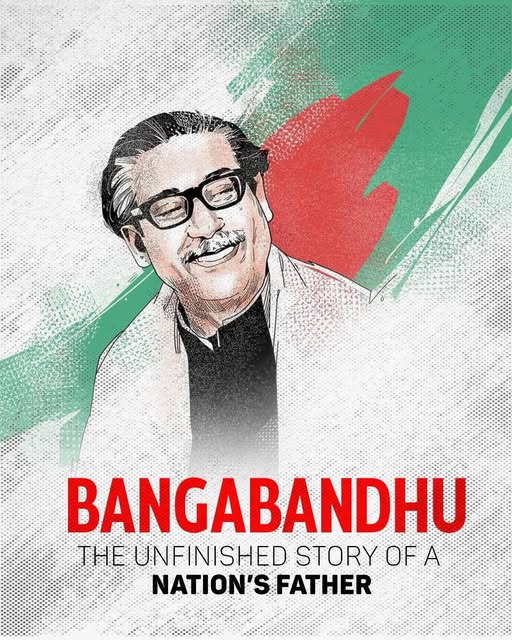
In history, there are certain individuals whose lives are not merely personal stories—they become reflections of a nation’s rise, struggle, and dreams.
Sheikh Mujibur Rahman is one such name, a history in himself. Under his leadership, we gained an independent country, a flag, and a national identity.
On March 17, 1920, a child named Mujib was born in Tungipara, Gopalganj, Bangladesh. At the time, no one could have imagined that the child from that quiet village would one day become an inseparable part of the birth of Bangladesh.
From his student life, he showed a deep interest in politics. In the late 1930s, his acquaintance with one of the most influential leaders of Bengal, Huseyn Shaheed Suhrawardy, brought a new dimension to his political philosophy. From Suhrawardy, Mujib learned that politics is not merely a struggle for power—it is about people’s rights, dignity, and justice.
In 1947, the end of British rule led to the creation of Pakistan. However, it quickly became clear that the people of East Bengal were not receiving equal rights in the new state. Discrimination in language, economy, and political power continued to intensify, creating frustration and anger among the people of East Bengal.
This reality made the young Mujib even more determined. In 1948, during the movement for the recognition of Bengali as a state language, he directly joined the protests. When repression was unleashed against activists demanding recognition of the Bengali language, Sheikh Mujib was arrested while observing a strike. Yet prison, cases, and fear could not stop him. His determination to stand for justice and people’s rights only grew stronger.
In 1949, a new political party was formed at Rose Garden Palace—the East Pakistan Awami Muslim League. The party was led by Abdul Hamid Khan Bhashani as president. Although Sheikh Mujib was in prison at the time, he was appointed Joint General Secretary.
Later, reflecting its secular ideals, the word “Muslim” was removed from the party’s name. The organization later became Bangladesh Awami League, one of the most important political forces in Bangladesh.
During the 1960s, politics in Pakistan grew increasingly turbulent. To establish the economic and political rights of East Pakistan, Sheikh Mujib announced the historic Six-Point Program, known as the charter of Bengali liberation. It demanded autonomy and posed a major political challenge to Pakistan’s ruling elite.
In 1968, Sheikh Mujib was charged with treason in the Agartala Conspiracy Case. But the situation soon changed dramatically. Under intense pressure from the 1969 Mass Uprising in East Pakistan, the government of Ayub Khan withdrew the case on February 22, 1969.
The following day, at a massive public reception in Racecourse Maidan, Sheikh Mujibur Rahman was formally honored with the title “Bangabandhu” (Friend of Bengal).
Then came the 1970 general election. In Pakistan’s first major democratic election, the Awami League won an overwhelming majority. However, delays and political maneuvering over the transfer of power plunged the country into a deep crisis.
On March 1, 1971, the then president of Pakistan, Yahya Khan, abruptly postponed the National Assembly session, sparking widespread anger among the people of East Bengal.
History has seen many wars of independence—some revolutions, some civil wars, some long and bloody conflicts. But the story of Bengali independence was different.
Behind it lay Bangabandhu’s long-term strategy, his step-by-step approach, and his extraordinary leadership in preparing an entire nation psychologically for freedom.
During the turbulent days of March 1971, waves of protests swept across Bengal—from Teknaf to Tetulia. The non-cooperation movement called by Bangabandhu spread nationwide while preparations for the final struggle continued.
Courts, offices, and institutions were shut down. Across the country, people defied the threats of the Pakistani military and held rallies, processions, and mass gatherings.
The eyes of a freedom-hungry nation remained fixed on House No. 32, Dhanmondi, awaiting Bangabandhu’s next directive.
On March 7, 1971, the entire nation waited with anticipation. Millions gathered at Racecourse Maidan.
Finally, he arrived—the great leader of the Bengali people, Bangabandhu Sheikh Mujibur Rahman.
In his resonant voice he delivered the immortal words:
“The struggle this time is the struggle for emancipation;
the struggle this time is the struggle for independence.”
For the extraordinary political vision and artistic brilliance with which he inspired the Bengali nation in that speech, the American magazine Newsweek described him on April 5, 1971 as the “Poet of Politics.”
Moreover, the historic 7 March Speech of Bangabandhu has been recognized by UNESCO as part of the Memory of the World documentary heritage.
Finally, on the night of March 25, 1971, the Pakistani military launched the infamous operation Operation Searchlight.
That night, Dhaka turned into a city of terror. Across the country, unarmed Bengalis were subjected to mass killings, arrests, torture, and destruction.
But this brutality could not suppress the Bengali people. Instead, the bloody night strengthened their resolve for independence.
Thus began one of the bloodiest chapters in history—the Bangladesh Liberation War, which after nine months of struggle and sacrifice led to the birth of an independent state: Bangladesh on December 16, 1971.
Even earlier, the architect of independence had already proclaimed the name Bangladesh. On December 5, 1969, at a discussion meeting of the Awami League, Bangabandhu officially declared that the land known as East Pakistan would henceforth be called Bangladesh.
After being released from a Pakistani prison, Bangabandhu returned home on January 10, 1972. His return completed the victory of the Liberation War.
Yet history can sometimes be cruel.
On August 15, 1975, Sheikh Mujibur Rahman and most members of his family were assassinated in a military coup carried out by a group of renegade army officers.
With that tragedy, not only was the life of a political leader ended, but a crucial chapter of Bangladesh’s history was abruptly cut short.
For many years after the assassination, Bangabandhu’s name and image almost disappeared from textbooks, news media, and even films in Bangladesh. It seemed as if a vital chapter of history had been deliberately obscured.
Even in recent times, attempts have been made by the defeated forces of 1971 to erase Bangabandhu and the spirit of the Liberation War.
After the meticulously designed political upheaval of July 2024, this trend became even more visible. The historic Dhanmondi 32, from where the independence movement was directed, was burned and demolished with bulldozers. Hundreds of sculptures related to Bangabandhu and the Liberation War were destroyed. Important national days associated with him were canceled, and even the title “Bangabandhu” was removed from textbooks.
Yet no matter how much enemies try, no matter how many conspiracies are woven
No one can erase Bangabandhu Sheikh Mujibur Rahman.
His name, ideals, and dreams remain forever alive in the hearts of the Bengali people.
His legacy will continue to live—
in every page of history,
in the depths of people’s hearts,
in every utterance of freedom,
and in the national identity of Bangladesh.
